
Most bike shops treat the workshop as a support act for bike sales. It's actually the highest-margin part of the business: labour typically earns about twice the margin of a new bike, and nobody can undercut it online.
That's the starting point for Maximizing Service Revenue, our four-part video series with the National Bicycle Dealers Association (NBDA), made for independent shop owners and service managers. Three parts are out now. Here they are in order, with what each one covers and the homework to do before the next.
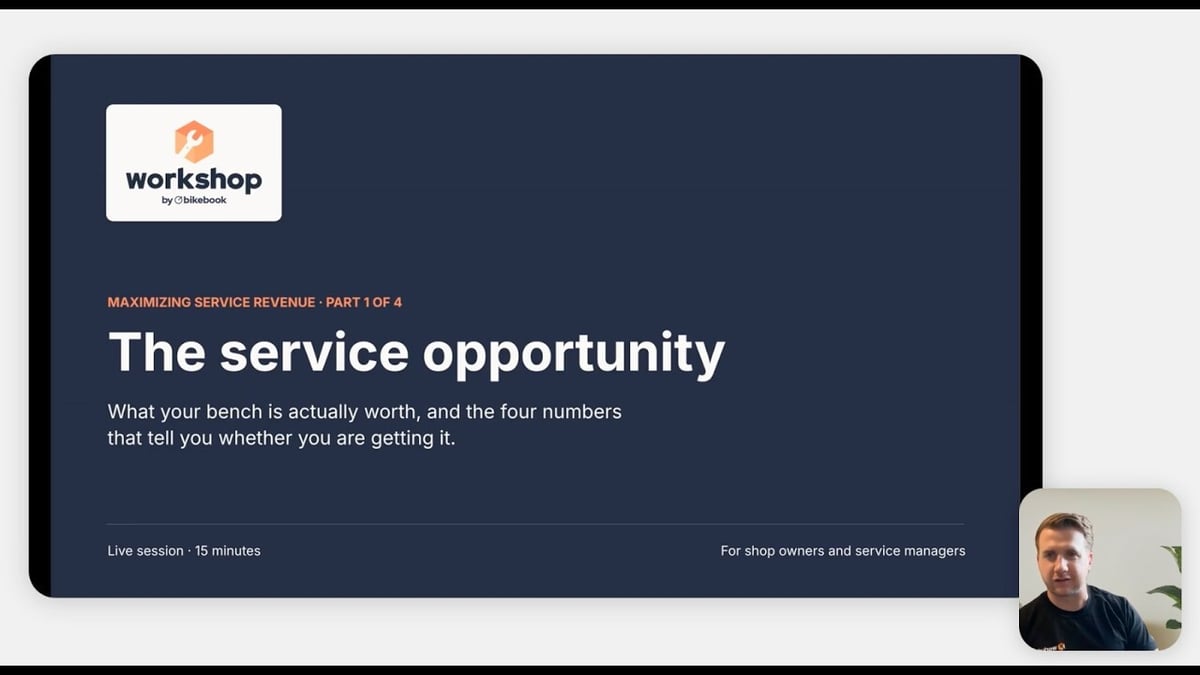
Part 1: The service opportunity
We work out how much one bench can earn in a year, why an unsold hour is lost for good, and the five places service revenue usually leaks out of a shop.
You'll leave with a simple four-number scoreboard to check every Monday and five actions to take before Part 2. None of them need any software.
Part 2: Getting bookings in
A booking you never hear about looks exactly like a quiet week. In Part 1, most shops found their bench running at around 54% utilisation, while a well-booked bench sits nearer 75%. Part 2 is about closing that gap with work, not discounts. It covers:
- The four ways a repair reaches your bench: walk-in, phone, local search and returning riders
- Why a ringing phone costs you twice, and what missed calls add up to over a year
- The three things a rider needs before they'll book online: a visible price, a date they can pick, and proof you do good work
- Building a simple three-tier service menu, and why most riders pick the middle one
- Writing quotes down and chasing them once, with the Day 0 / Day 2 / Day 7 rule
Homework before Part 3: keep a tally of every call you couldn't answer, write your three service tiers with prices, put those prices where riders can see them, check your shop listing, and follow up every open quote in writing.
Part 3: Running the bench efficiently
A full diary is only worth something if bikes move through it. Part 3 looks at what happens once the bike is through the door:
- Eight hours paid, six chargeable: where the missing two hours go
- The five states every bike in your shop should be in, and the counter test for your job board
- Why a stalled job costs you three times, and the three reasons jobs stall
- The ten parts lines that cover most of what you fit, and when to order at booking
- What an hour on your stand really costs, and the labour rate you need above it
- Making extra work easy to approve: a photo, a price and one yes-or-no question
The worked example shows the same diary after six weeks of tighter flow, with lead time down from eight days to three.
Homework before Part 4: count the bikes waiting on parts or approval this Monday morning, list your ten most-fitted parts and check stock against them, work out the real cost of an hour on your stand, agree the photo, price and question script with your bench, and charge for every consumable you fit for one full week.
Coming next: Part 4
Part 4 is about turning jobs into repeat revenue: service plans, reminders and reviews that bring the same bike back twice a year. Bring your Monday stalled-job count. Subscribe on YouTube to catch it when it lands.
Figures in the series are industry averages and illustrations, so swap in your own numbers.
Where Workshop fits
Everything in the series works on paper. If you'd rather not, Workshop by Bikebook puts online bookings, walk-ins and quotes into one diary limited by your real bench capacity, and every job on one board the whole bench works from. Approvals go out from the stand, parts are booked against each job, and you can see everything that's waiting and for how long.
Book a demo and we'll show you on your own numbers.