
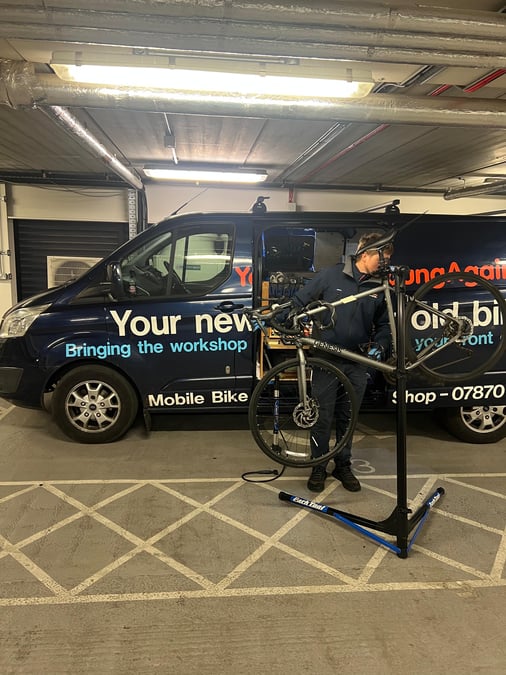
Running a mobile bike repair operation means your workshop is wherever the van is parked. Between customer calls, roadside derailleur adjustments and chasing invoices from the kitchen table, the right workshop management software can reclaim hours you currently lose to boring admin tasks. The wrong one can make things worse.
This comparison breaks down five platforms built for or commonly used by mobile bike mechanics and on-site repair teams. You will find clear criteria around bookings, digital job cards, customer updates, inventory and workflow fit so you can make a confident decision for your business.
Workshop by Bikebook gives you a service-first workflow built specifically for the cycling industry, connecting bookings, jobs, customer updates, parts, invoices and payments from one place. Below, you will see how it stacks up alongside four alternatives.
Quick guide: 5 best workshop software for mobile bike mechanics
- Workshop by Bikebook: The best workshop management platform for mobile mechanics who need bookings, digital job cards, route planning, invoicing and customer updates in a single cycling-specific workflow.
- Hubtiger: Online booking widgets and automated customer notifications for bike repair shops that handle most work in a fixed location.
- Velodrop: Scheduling-focused platform with SMS reminders and calendar-based capacity management for independent workshops.
- BikeDesk: EPOS-led system combining counter sales, repairs and webshop functionality for bike retailers in Europe.
- Lightspeed Retail: Retail POS with vendor catalogues, serialised inventory and ecommerce sync for larger bike retailers with a service counter.
How we chose the best workshop software for mobile bike mechanics
Every mobile mechanic's day looks different, but the operational pain points are consistent: missed calls while you are elbow-deep in a bottom bracket, invoices that pile up until Sunday evening, and customers who ring three times to ask if their bike is ready. We evaluated these platforms based on how well they solve those specific problems.
- Mobile-ready workflow: Can you run your full day from a phone or tablet, including bookings, job updates, invoicing and payments, without returning to a desk?
- Booking and scheduling: Does the platform let your customers book online while you keep control of capacity, travel time and daily routes?
- Digital job cards and service history: Can you create, update and close jobs on site with photos, notes and parts attached to the customer record?
- Customer communication: Does the system send automatic status updates so you spend less time on time-consuming phone calls and more time turning wrenches?
- Invoicing and payments: Can you raise an invoice and take payment at the customer's doorstep without a separate app or spreadsheet?
- Inventory and parts management: Does the software track stock usage against jobs so you know what is in the van before you leave in the morning?
- Integrations: Does the platform connect with accounting, POS, ecommerce and payment providers you already use?
The 5 best workshop software for mobile bike mechanics
1. Workshop by Bikebook: Best overall workshop software for mobile bike mechanics
Workshop by Bikebook was built by people who understand the cycling trade from the inside, developed in close collaboration with Cytech-registered mechanics. It connects bookings, digital job cards, service history, customer updates, stock, invoices, payments, reporting and integrations into one workflow designed for how repair businesses actually operate.
For mobile mechanics specifically, the Workshop app puts your entire operation in your pocket. You can book jobs, update statuses, raise invoices and take payments from the van or the trailside, with everything syncing instantly to the desktop. The built-in route planner orders your day's stops along the most efficient path, showing distance, driving time and estimated duration so you can fit more jobs into fewer kilometres.
Workshop by Bikebook can save a mechanic up to 10 to 15 minutes on a major service through automated customer updates, digital approvals and connected invoicing. The platform is designed to boost customer retention by up to 22%, because your customers stay informed at every stage without a single call from your end.
Workshop by Bikebook features
- Route planner for mobile mechanics: The app sequences your day's stops by shortest path and provides driving time estimates, so you reduce fuel costs and fit more appointments into each round.
- Digital job cards with photo approvals: Find extra work mid-service? Send the customer a photo and a price. They approve with one tap while you keep working, and nobody plays phone tag.
- Automated customer updates: SMS and email notifications send themselves as a job moves through your custom statuses, and customers can watch progress live instead of calling.
- On-site invoicing and payments: Raise the invoice at the customer's door and take payment through SumUp, Stripe or Zettle. The payment lands against the job automatically.
- Service history per customer and bike: Every job, part, quote and note stays attached to the customer and their bicycle, so you never lose context between visits.
- Connected integrations: Workshop syncs with Shopify, Square, Lightspeed, Xero, Saledock, Celerant and supplier catalogues including Upgrade Bikes and Bicycle Parts Wholesale.
Workshop by Bikebook pros and cons
- Pro: Purpose-built for the cycling industry, so the workflow matches how mobile mechanics and workshops actually operate day to day.
- Pro: The mobile app and route planner are included with every plan at no extra cost, making it practical for sole traders and small teams alike.
- Pro: Integration range spans ecommerce, POS, accounting, payments and suppliers, keeping your operation connected without duplicate data entry.
- Con: Mechanics already using a POS-heavy retail setup may need time to map their existing catalogue into Workshop's service-first workflow.
- Con: Some advanced reporting features are available on higher-tier plans, so sole traders should check which reports they need at the outset.
- Con: As a cycling-specific platform, it does not cover general retail categories outside the bike trade.
2. Hubtiger: Automated booking and repair notifications for fixed-location shops
Hubtiger is a repair-focused booking platform used by bike shops that handle most customer interactions at a fixed counter. It offers online booking widgets, digital job cards and automated customer messaging through email, SMS and WhatsApp. Shops like 99 Bikes in Australia use Hubtiger to manage repair workflows and notify customers when jobs are ready for collection.
For mobile mechanics, Hubtiger's core feature set is oriented around a shop counter rather than a van. Online bookings and automated notifications work well if your customers drop off bikes at a fixed address, but the platform does not include a route planner or mobile-first invoicing workflow for on-site visits.
Hubtiger features
- Online booking widget: Customers book through your website, and the system captures intake details before the bike arrives.
- Automated messaging: Choose which repair stages trigger notifications, and deliver them by email, SMS or WhatsApp.
- Two-way messaging: Every customer conversation stays attached to the job it belongs to, reducing scattered texts and missed messages.
Hubtiger pros and cons
- Pro: Automated customer notifications across multiple channels reduce time spent on status calls during busy workshop days.
- Pro: The booking widget embeds on your existing website, giving customers a self-service intake option.
- Pro: Two-way messaging keeps communication centralised within each job record.
- Con: The platform does not include route planning or location-based scheduling features designed for mobile service rounds.
- Con: Inventory management and stock tracking are not a core focus of the platform.
- Con: Accounting and payment provider integrations are more limited than platforms with a broader connector library.
3. Velodrop: Calendar scheduling and SMS reminders for independent workshops
Velodrop focuses on scheduling, capacity management and SMS-based communication for bike shops that run appointment-driven service departments. It offers 24/7 online booking, automated reminders, digital work orders and a calendar view that shows the day's workload at a glance. Shops like Giant Hampton in Australia and SW Bicycle Company in London use Velodrop to manage daily scheduling.
The platform integrates with Lightspeed Retail and Shopify for retail-side data, which helps retailers that run both a shop floor and a service counter. For mobile mechanics, Velodrop's scheduling tools work for managing appointments, but the platform does not offer on-site invoicing, a route planner or mobile-specific payment integrations.
Velodrop features
- Capacity-based scheduling: Set staff shifts and appointment availability so the workshop runs at capacity without overbooking.
- SMS and email automation: Automated reminders reduce no-shows, and one-click completion notifications let customers know their bike is ready.
- Digital work orders: Create, assign and track jobs from a calendar view with notes, status updates and custom service categories.
Velodrop pros and cons
- Pro: Visual scheduling and capacity management help workshops avoid overbooking during peak periods.
- Pro: Integrations with Lightspeed Retail and Shopify connect retail inventory data with service scheduling.
- Pro: Custom service categories and colour-coded classes help organise different job types.
- Con: The platform does not include invoicing, payment processing or accounting integrations within the core product.
- Con: Mobile mechanics will not find route-planning or on-site payment capture features built into the workflow.
- Con: The integration library is limited to a smaller number of POS platforms compared with broader workshop tools.
4. BikeDesk: EPOS and webshop for European bike retailers
BikeDesk combines point-of-sale, workshop ticket management, webshop functionality and stock control for bike shops. The platform was founded in Denmark and serves over 6,000 bike shop staff across Europe, with a UK support line and multi-language capability. Workshop tickets include status tracking, SMS updates for customer pickups, and built-in payment processing.
BikeDesk's strength is connecting retail sales with repair operations through a single EPOS interface. For mobile mechanics, the system is designed around a shop counter and retail floor rather than an on-the-road service workflow. There is no route planner or dedicated mobile service scheduling feature for mechanics who visit customer locations.
BikeDesk features
- Workshop tickets: Create and manage repair cases with status updates, task assignments and customer notifications from a list or calendar view.
- Built-in POS: Accept cash, card and gift card payments through the same system that manages repair jobs.
- Webshop integration: Sync products and stock between your physical shop and your online store through BikeDesk's connected webshop.
BikeDesk pros and cons
- Pro: Combines retail POS, repairs, stock control and webshop in one system, reducing the need for separate tools.
- Pro: Automated SMS updates notify customers when their bike is ready, cutting down on status-chasing calls.
- Pro: The system works on any device and supports multi-user access across the team.
- Con: The platform is oriented around fixed retail locations rather than mobile service routes and on-site visits.
- Con: Integration options outside the BikeDesk ecosystem are narrower than platforms with open connector libraries.
- Con: Some workflow features require staff training on intake consistency to maintain clean records.
5. Lightspeed Retail: POS and serialised inventory for larger bike retailers
Lightspeed Retail is a retail POS platform used by bike shops for inventory management, vendor catalogues, ecommerce and service orders. The system tracks serialised inventory including frame serial numbers linked to customer profiles, which helps larger retailers manage both sales and repair tracking from a single platform. Lightspeed reports that 1 in 2 US bike retailers use the platform.
Lightspeed's repair-tracking features operate through service orders built into the POS, which means repair data lives alongside retail transactions. For mobile mechanics, the platform is designed for a retail-first operation with a physical counter. It does not include mobile-specific features like route planning, on-site field invoicing or van-based job management.
Lightspeed Retail features
- Serialised inventory tracking: Track individual bicycle frames and components with serial numbers linked to customer records for service history retrieval.
- Vendor catalogue integration: Order from multiple suppliers and the built-in NuORDER catalogue with purchase orders managed inside the POS.
- Ecommerce sync: Sell online, on social media and on marketplaces, all connected to your in-store inventory and customer data.
Lightspeed Retail pros and cons
- Pro: Serialised inventory and service order tracking offer detailed stock visibility for shops managing large parts catalogues.
- Pro: Built-in vendor catalogues and purchase orders simplify reordering from cycling-specific suppliers.
- Pro: Ecommerce integration keeps online and in-store stock counts synchronised across locations.
- Con: The platform does not include a mobile route planner, on-site invoicing or field-based job management features for mobile mechanics.
- Con: Workshop scheduling and capacity planning beyond service order status tracking require additional configuration or external tools.
- Con: Complex labour-rate rules across different service types may need careful setup to keep repair estimates consistent.
Comparison table: The best workshop software for mobile bike mechanics
| Platform | Mobile route planner | On-site invoicing and payments | Automated customer updates |
|---|---|---|---|
| Workshop by Bikebook | ✓ | ✓ | ✓ |
| Hubtiger | ✗ | ✗ | ✓ |
| Velodrop | ✗ | ✗ | ✓ |
| BikeDesk | ✗ | ✓ | ✓ |
| Lightspeed Retail | ✗ | ✗ | ✗ |
What should mobile bike mechanics look for in workshop software?
Your workshop is a van, a set of tools and a phone. That changes everything about what you need from software. Fixed-location workshop systems assume you have a counter, a till and staff who stay in one building. Mobile mechanics need the job, the customer and the payment to travel with them.
Look for a platform that handles the full cycle on a mobile device: booking, job creation, status updates, parts tracking, invoicing and payment capture. If you have to return to a laptop to close out jobs, the system is creating admin instead of removing it.
According to an Ipsos study commissioned by the UK Department for Business and Trade (2025), smaller businesses often find the anticipated difficulty of adopting new technology is higher than the actual experience. The report found that once SMEs implemented workflow-specific tools, time savings and operational improvements followed more quickly than expected.
How do you manage inventory as a mobile bike mechanic?
Inventory management looks different when your stock room is a set of shelves in the van. You need to know what is on hand before each round of calls, and every part you use on a job should deduct from your stock count without a separate spreadsheet at the end of the day.
Workshop by Bikebook tracks parts usage against each job through connected integrations with supplier catalogues, so you can see stock levels from the app and reorder before you run out. Connecting parts to jobs also means your invoices reflect exactly what was used, with no guesswork at the end of the week.
- Track van stock separately from shop stock if you also run a fixed location.
- Use digital job cards to log parts as you fit them so the numbers stay accurate.
- Connect your supplier accounts so reordering happens from the same system you use to manage jobs.
Why Workshop by Bikebook is the best workshop software for mobile bike mechanics
Most workshop software was built with a shop counter in mind. Workshop by Bikebook starts from a different place: the service workflow. It was designed by people in the cycling trade, built with input from Cytech-registered mechanics, and it connects everything a mobile operation needs into one place.
The route planner alone changes how your day works. Instead of guessing the order of your stops, the Workshop app plots the shortest path and gives you distance and time estimates so you fit more jobs into fewer hours. Add on-site invoicing through SumUp, Stripe or Zettle, and you close the loop before you leave the customer's driveway.
Workshop by Bikebook connects your bookings, digital job cards, customer communication, stock, invoices, payments and reporting so nothing falls through the gaps. For mobile mechanics and on-site repair teams who want to spend less time on boring admin tasks and more time doing the work they love, Workshop by Bikebook is a partner for your business. Start your free trial and see how it runs on the road.
FAQs about workshop software for mobile bike mechanics
What is workshop management software for mobile bike mechanics?
Workshop management software for mobile mechanics handles bookings, digital job cards, customer updates, invoicing and payments from a mobile device. Workshop by Bikebook includes a mobile app with route planning, on-site payment capture and instant sync, so your entire operation travels with you.
Can I manage bookings and payments from my phone?
Yes, if your platform supports a mobile-first workflow. Workshop by Bikebook lets you view your calendar, book jobs, raise invoices and take card payments through SumUp, Stripe or Zettle directly from the app. Every transaction lands against the right job automatically.
Do I need separate software for invoicing and accounting?
Not necessarily. Workshop by Bikebook generates invoices from the job record and integrates with Xero for accounting handoff, reducing reconciliation work. You raise the invoice, take the payment and the numbers sync through to your accounts.
How does route planning work in workshop software?
Workshop by Bikebook's route planner sequences your day's appointments along the shortest path. It shows estimated driving time, distance and job duration, helping you fit more calls into each day while reducing fuel costs and travel time between stops.
Is workshop software worth it for a sole trader mechanic?
Sole traders often lose the most time to boring admin tasks because there is no one else to handle bookings, invoicing or customer updates. Workshop by Bikebook is designed to be simple enough for a one-person operation while saving measurable hours each week. The free trial lets you test the full workflow before committing.