
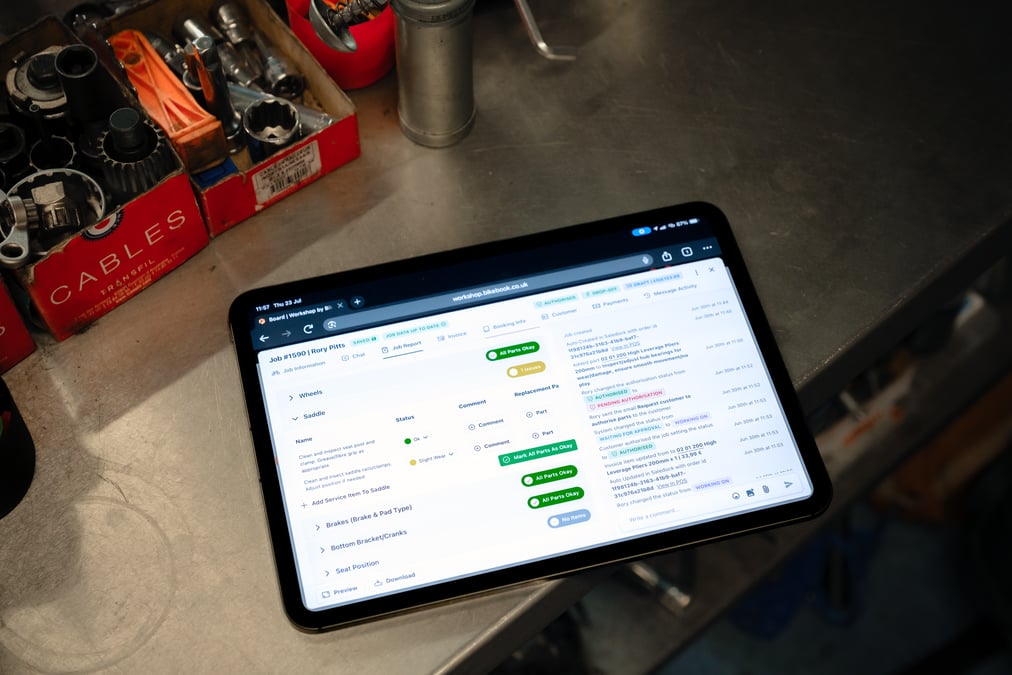
Paper job cards have a way of vanishing at the worst possible moment. Mid-service, a grease-smudged card slips behind the workbench, a customer calls for an update you can't find, and that parts approval you scribbled down yesterday? Gone. For independent bike workshops, this kind of chaos costs real hours and real revenue every single week.
The fix is straightforward: replace the paper trail with digital job cards that track every service from booking to collection. Workshop by Bikebook gives you that workflow in a system built specifically for cycling businesses, connecting bookings, jobs, customer updates, parts, invoices and payments in one place. This guide compares five tools so you can find the right fit for your workshop.
Quick guide: 5 best digital job card tools for bike workshops
- Workshop by Bikebook: The best workshop-first digital job card system built for independent bike shops and mobile mechanics
- Hubtiger: Repair-focused booking and job card software used across multiple service industries
- Lightspeed Retail: Retail POS with service order tracking added for bike shops running a sales floor alongside repairs
- Velodrop: Online booking and work order scheduling tool for bike shops wanting to reduce phone calls
- Bikedesk: Combined POS and workshop ticket system designed in Denmark for European bike retailers
How we chose the best digital job card tools for bike workshops
Picking the right tool means thinking like a working mechanic, not like a software reviewer. We looked at each platform through the lens of a busy Tuesday morning: bikes stacking up, customers expecting updates, and no time for clunky menus.
- Job card depth: Can you create, assign and track a repair from drop-off to collection without switching screens? The fewer clicks between you and the next job, the better.
- Customer communication: Does the tool send automatic status updates so your customers stop calling to ask "is my bike ready?" Your phone should ring less, not more.
- Online booking: Can customers book their own slot through your website, even at 9pm on a Sunday? That frees your mornings for the stand, not the phone.
- Parts and stock visibility: When you find a worn chain mid-service, can you check stock levels and get approval without leaving the Job Card? This keeps work flowing and avoids delays.
- Integration with existing tools: Does it connect with your POS, accounting software and payment provider? Double entry is the enemy of a profitable workshop.
- Cycling industry fit: Was the platform built for bike workshops specifically, or adapted from a generic repair tool? Trade-specific features save setup time and reduce workarounds.
The 5 best digital job card tools for bike workshops
1. Workshop by Bikebook: Best overall digital job card system for bike workshops
Workshop by Bikebook is a purpose-built workshop management system designed in collaboration with Cytech-registered mechanics and cycling trade professionals. It connects every stage of a repair job, from the moment a customer books online through to final payment and collection, inside one workflow that was built around how bike workshops actually operate.
Your mechanics and your customers see the same job status at the same time. When a job moves from "on the stand" to "bike ready," Workshop by Bikebook sends an automatic SMS or email update. No more interruptions to answer "is it done yet?" calls while you're mid-bleed on a set of hydraulic brakes.
Workshop by Bikebook connects your payment providers directly to job records. Take a deposit at booking through Stripe, collect the balance in-store via Zettle or SumUp, and everything reconciles against the right Job Card without end-of-day spreadsheet work. The platform also integrates with Shopify, Lightspeed, Xero, and cycling-specific suppliers like Upgrade Bikes.
Aztec Bikes, a solo-mechanic workshop in the UK, reported saving five hours every week after switching to Workshop by Bikebook. Owner Marco Garcia described the change simply: "Everything in one place, much easier to manage. Customers get instantly updated."
Workshop by Bikebook features
- Digital Job Cards with live tracking: Create, assign and progress jobs through custom statuses you define yourself. Your mechanics work from the Calendar, List or Board View, and customers track progress live from their phone.
- Online booking with deposits: Customers book through your website with a deposit taken at the point of booking. Both online and counter bookings land in the same schedule with capacity limits, so you never overbook.
- One-tap parts approval: Find extra work mid-service? Send the customer a photo and a price. They approve with one tap, you keep working, and nobody plays phone tag.
- Automated customer updates: SMS and email notifications trigger automatically as job status changes. You set the statuses and the messages once, and Workshop handles the rest.
- Connected stock and supplier data: Live stocklists from cycling-specific suppliers keep your parts information current. When a part is used on a job, stock levels update across the system.
- Multi-location and enterprise support: For growing groups, Workshop Enterprise lets each store run its own diary while head office sees the full picture, with role-based permissions and standardised processes across branches.
Workshop by Bikebook pros and cons
Pros:
- Built specifically for the cycling industry with Cytech-registered mechanic input and supplier integrations (Upgrade Bikes, Bob Elliot, Zyrofisher)
- Workshop by Bikebook connects bookings, job cards, customer updates, stock, invoices and payments in a single workflow, reducing the tab-switching that drains workshop time
- Available in 15 countries across Europe, North America and Australia, each in its own language
Cons:
- Workshops unfamiliar with digital tools may need a short onboarding period, though a 28-day free trial gives plenty of time to settle in
- Some advanced integrations (such as Celerant for larger retail groups) are better suited to the Enterprise plan
- The platform's cycling-trade focus means businesses outside the bike industry may find fewer pre-built templates for their specific workflows
2. Hubtiger: Repair booking and job card software for multi-industry workshops
Hubtiger offers cloud-based repair management software used across bike shops, ski workshops and other service businesses. The platform includes online booking, digital job cards, automated customer notifications and a colour-coded calendar view for tracking repair progress. Hubtiger integrates with several POS systems, allowing shops without a separate point-of-sale tool to manage products and services directly within the platform.
Hubtiger also includes a rental management module, which may suit bike shops that offer demo or hire fleets alongside their repair service. The platform focuses on reducing phone-based communication by sending status updates via email, SMS or WhatsApp at configurable repair stages.
Hubtiger features
- Digital job cards with checklists: Each repair gets a job card with notes, photos and configurable checklists attached before the mechanic starts work.
- Customisable notifications: Choose which repair stages trigger an update and select between email, SMS or WhatsApp delivery for each.
- Rental management module: Manage demo bikes and rental fleets with online reservations, digital waivers and fleet tracking alongside repair operations.
Hubtiger pros and cons
Pros:
- Includes WhatsApp as a notification channel alongside SMS and email, which offers an additional way to reach customers
- The rental module gives shops that run demo or hire fleets a combined booking system for repairs and rentals
- Used across multiple industries, so workshops that also service other equipment can use one platform
Cons:
- Not built specifically for the cycling trade, so bike-specific supplier integrations and cycling parts catalogues are not included
- Multi-industry focus means the platform includes features and interface elements that bike-only workshops may not need
- POS functionality is limited compared to dedicated retail systems, requiring a separate POS for shops with significant counter sales
3. Lightspeed Retail: POS-first platform with service order tracking for bike retailers
Lightspeed Retail is a general retail POS system used across many industries, including bike shops. Its service order module lets you create repair tickets, track progress through status stages and leave notes on each job. The platform's core focus is retail inventory management, vendor catalogues and ecommerce, with workshop functionality added as an extension of the sales workflow.
For shops where retail represents the majority of revenue and the workshop is a supporting department, Lightspeed Retail offers the advantage of managing both from a single login. The service order module covers basic repair tracking, scheduling up to 14 days in advance and seven configurable status labels.
Lightspeed Retail features
- Service orders within POS: Create service tickets, assign status labels and track repairs alongside retail transactions from the same system.
- Vendor catalogues and purchasing: Access built-in vendor catalogues and create purchase orders directly from the POS to keep stock levels current.
- Serialised inventory tracking: Track individual bike frames, components and accessories by serial number for warranty and service record purposes.
Lightspeed Retail pros and cons
Pros:
- Retail inventory management includes serialised tracking, vendor catalogues and multi-location stock visibility
- Ecommerce and social media selling capabilities are included, which suits shops that sell online as well as in-store
- Offers a broad integration marketplace with connections to accounting, loyalty and marketing tools
Cons:
- The service order module covers basic repair tracking but does not include automated customer SMS updates, online booking or digital parts approval
- Workshop-specific features like job card workflows, mechanic assignment views and live customer tracking are not part of the native system
- Service scheduling is limited to 14 days in advance, which may not suit workshops that book further ahead during busy seasons
4. Velodrop: Online booking and work order scheduling for bike shops
Velodrop is a cloud-based booking and work order management tool built for independent bike shops. The platform focuses on replacing phone bookings and paper work orders with an online self-service flow. Customers book through a personalised public page or embeddable widget, and the resulting work order appears on the shop's scheduling dashboard with all details attached.
Velodrop integrates with Lightspeed Retail and Shopify for shops that need POS connectivity alongside their workshop scheduling. The platform includes SMS messaging for appointment reminders and job completion updates, with credit-based SMS pricing.
Velodrop features
- Online self-service booking: Customers book repairs through your shop's branded booking page or an embeddable website widget without needing to call.
- Visual appointment calendar: View your workshop workload at a glance with drag-and-drop scheduling and capacity planning to prevent overbooking.
- SMS automation: Send automated appointment reminders and one-click completion notifications to reduce no-shows and manual follow-up.
Velodrop pros and cons
Pros:
- The booking widget embeds directly into your existing website, letting customers self-serve without a separate portal
- Integrates with both Lightspeed Retail and Shopify for shops that need POS connectivity
- Unlimited employees included on every plan, so adding team members does not increase the subscription cost
Cons:
- SMS messaging uses a credit-based system, so high-volume shops may need to purchase additional credits beyond the monthly allowance
- Does not include invoicing, accounting integrations or built-in payment processing, so you need separate tools for billing
- Inventory and parts management are not included, meaning stock tracking must happen in a connected POS or manually
5. Bikedesk: Combined POS and workshop ticket system for European bike retailers
Bikedesk is a Danish-built POS and workshop management system designed for bike shops. The platform combines point-of-sale functionality with digital workshop tickets, allowing shops to manage counter sales and repairs from one interface. Bikedesk includes automatic SMS updates for customers, online ticket tracking and a booking system that turns website enquiries into workshop tickets.
With over 6,000 bike shop users since 2016, Bikedesk has established a presence across European markets. The platform runs entirely online and works across devices, so mechanics can create and update tickets from a phone, tablet or desktop on the workshop floor.
Bikedesk features
- Integrated POS and workshop tickets: Manage retail sales and repair jobs from the same system, reducing double entry between the counter and the workshop.
- Online booking to instant tickets: Website bookings automatically create a workshop ticket with customer details, service type and schedule already filled in.
- Customer ticket tracking: Customers can check the status of their repair online without calling the shop, which reduces phone interruptions during busy periods.
Bikedesk pros and cons
Pros:
- Combines POS and workshop management in one system, which reduces the need for separate retail and repair software
- Automatic SMS updates and online ticket tracking keep customers informed without manual effort from your team
- Runs on any device with a web browser, so mechanics can update tickets from a tablet at the workbench
Cons:
- The platform is primarily designed for European markets, so supplier catalogue integrations outside Europe are limited
- Does not include cycling-specific supplier connections or live stock feeds from UK parts distributors
- Online booking generates a workshop ticket but does not include deposit collection at the point of booking
Comparison table: The best digital job card tools for bike workshops
| Tool | Cycling-Specific Build | Online Booking with Deposits | One-Tap Parts Approval |
|---|---|---|---|
| Workshop by Bikebook | ✓ | ✓ | ✓ |
| Hubtiger | ✗ | ✓ | ✗ |
| Lightspeed Retail | ✗ | ✗ | ✗ |
| Velodrop | ✓ | ✗ | ✗ |
| Bikedesk | ✓ | ✗ | ✗ |
How do digital job cards reduce admin time in a bike workshop?
Every paper job card that gets lost, smudged or misfiled adds minutes to your day. Multiply that across 15 or 20 jobs a week, and the admin creep is significant. Digital job cards eliminate the transcription step entirely: when a customer books online, the Job Card is created automatically with their details, bike information and selected service already filled in.
Automatic status updates remove the need to call or text customers manually. According to Business Research Insights (2026), the garage management software market is valued at USD 0.48 billion and is forecast to reach USD 1.33 billion by 2035 at a 9.8% CAGR, reflecting how quickly service businesses are moving away from paper-based processes.
Workshop by Bikebook takes this further by connecting each Job Card to your stock, invoicing and payment workflow. When a part is used on a repair, stock levels update automatically. When the customer approves extra work, the invoice adjusts in the same record. No re-keying, no separate systems, no end-of-day reconciliation.
What should a bike workshop look for when switching from paper to digital?
The biggest risk when switching systems is adding complexity instead of removing it. A tool that requires weeks of configuration or a separate IT resource to maintain is unlikely to survive a busy spring season in your workshop.
Look for a platform that matches your existing workflow rather than forcing a new one. Your custom statuses (like "Waiting for parts" or "On the stand") should be configurable, not locked to a generic template. The system should let your mechanics work from a view that makes sense for them, whether that is a calendar, a list or a board.
Integration matters from day one. If your shop runs on Shopify, Xero or a specific payment provider, check that the digital job card tool connects natively rather than through a workaround. Workshop by Bikebook integrates with Shopify, Lightspeed and Xero alongside your existing tools so your stack stays intact.
Why Workshop by Bikebook is the best digital job card tool for bike workshops
Most digital job card tools on this list were built for general repair businesses or retail operations first. Workshop by Bikebook was built for bike workshops from day one, developed alongside Cytech-registered mechanics who understand the difference between a groupset overhaul and a quick tyre swap.
That cycling-trade specificity shows in every part of the system. Workshop by Bikebook connects your bookings, Job Cards, customer updates, stock, invoices, payments and reporting in a single workflow designed around service-led operations. Supplier integrations with Upgrade Bikes and cycling distributors mean your parts data stays current without manual stock counts.
Workshop by Bikebook can save a mechanic up to 10 to 15 minutes on a major service and is designed to boost customer retention by up to 22%. With a 28-day free trial and competitively priced plans, that time saved pays for itself quickly. Book a demo and see how it works on your own bookings and jobs.
FAQs about digital job cards for bike workshops
What is a digital job card in a bike workshop?
A digital job card is an electronic record that tracks a repair from booking to collection. Workshop by Bikebook creates one automatically when a customer books online, with their details, bike information and selected service already attached. You update the status as the job progresses, and your customer sees the changes in real time.
Can digital job cards replace paper work orders completely?
Yes. A digital job card holds every detail a paper card would, plus photos, parts approvals, customer messages and payment records. Workshop by Bikebook stores the full service history for every bike and every customer, so returning jobs start with context already on screen.
How long does it take to set up a digital job card system?
Most bike workshops using Workshop by Bikebook are up and running within a day. You configure your services, statuses and booking page, then start creating Job Cards. The 28-day free trial gives you time to test the workflow on real jobs before committing.
Do digital job card tools integrate with accounting software?
Workshop by Bikebook integrates with Xero, so invoices and payments flow from the Job Card into your accounts without manual re-entry. This reduces reconciliation time and keeps your financial records aligned with your workshop activity.
Are digital job cards useful for mobile bike mechanics?
Absolutely. Workshop by Bikebook includes field management features built for mechanics on the move. Access customer details, job notes, invoices and payments from your phone, take deposits on-site and send automatic updates to customers between stops.